Organic vs. Conventional Yield & Labor Estimator
Use this tool to visualize the "Yield Gap" and labor intensity discussed in the article. Adjust the inputs to see how switching methods affects land usage and workforce requirements.
Production Impact Analysis
You would need 0 more acres of organic land to produce the same amount of food.
This additional land often comes from clearing forests or grasslands, impacting global biodiversity.
Without herbicides and pesticides, organic farming requires significantly more manual weeding and pest monitoring, driving up costs.
There is a glow around organic farming that makes it sound like the perfect solution to every environmental problem. We see the label on our groceries and assume it means healthier food, happier soil, and a cleaner planet. But if you actually look at the data behind large-scale production, the picture gets a lot more complicated. It isn’t just about avoiding synthetic chemicals; it’s about trade-offs. Two specific criticisms stand out when experts analyze the real-world impact of this method: significantly lower crop yields per acre and substantially higher labor requirements.
Understanding these downsides doesn't mean organic farming is "bad." It means it has limits. If we want to feed a growing global population while protecting the environment, we need to know exactly where this system struggles. Let’s look at the hard numbers and the practical realities that critics point to.
The Yield Gap: Feeding More People with Less Land
The most frequent and scientifically backed criticism of organic agriculture is its lower productivity compared to conventional farming. When you remove synthetic fertilizers and pesticides from the equation, plants often don't grow as big or as fast. This creates what researchers call the "yield gap."
A massive meta-analysis published in Nature Plants by Seufert et al. (which reviewed over 400 studies) found that organic methods produce, on average, about 25% less food than conventional methods. For some crops, like wheat and corn, that gap can be even wider, reaching up to 30-40%. Why does this matter? Because land is finite.
| Crop Type | Conventional Yield (Tonnes/Ha) | Organic Yield (Tonnes/Ha) | Yield Gap (%) |
|---|---|---|---|
| Wheat | 8.0 | 5.5 | ~31% |
| Corn (Maize) | 10.5 | 7.0 | ~33% |
| Potatoes | 40.0 | 30.0 | ~25% |
| Apples | 35.0 | 28.0 | ~20% |
Critics argue that if we switch all farmland to organic methods, we would need millions more hectares of land to produce the same amount of food. Where does that land come from? Often, it means clearing forests or converting grasslands. This process, known as land-use change, releases stored carbon into the atmosphere and destroys habitats for wildlife. So, while organic farming might be better for the soil *on that specific farm*, it could hurt the global environment by forcing expansion into wild areas.
This is particularly tricky in regions with high population density, like parts of Europe or Asia, where there is simply no spare land to expand onto. The criticism here isn't just about economics; it's about ecological efficiency. Is it truly "green" if your method requires twice the land to feed the same number of people?
The Labor Problem: High Costs and Human Strain
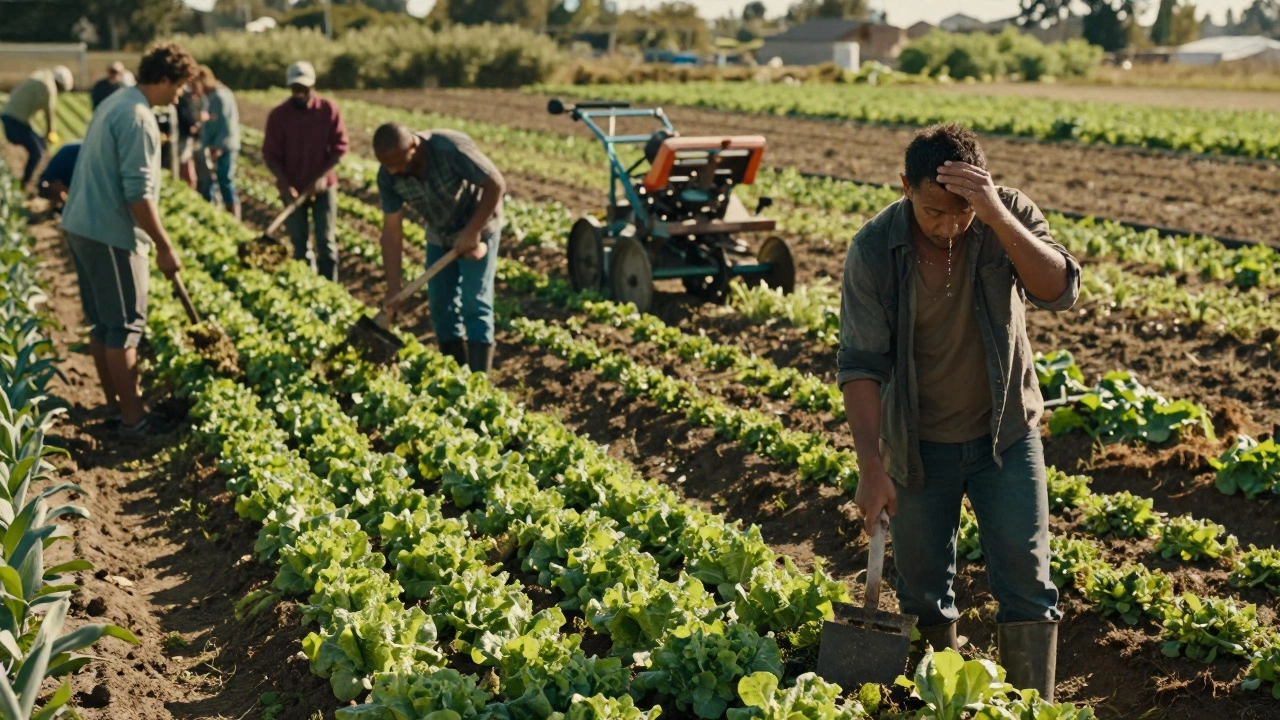
The second major criticism focuses on human resources. Organic farming is incredibly labor-intensive. Without herbicides to kill weeds, farmers have to pull them by hand or use mechanical tillers. Without broad-spectrum insecticides, they have to monitor fields constantly and release beneficial insects or spray natural predators like neem oil, which often requires more applications than synthetic alternatives.
This reliance on manual work drives up the cost of production. You’ve probably noticed that organic berries or spinach cost significantly more at the supermarket. That price tag reflects the hours of human labor needed to keep those crops healthy. For small family farms, this can be manageable. But for large-scale operations trying to compete in a global market, the labor bill becomes unsustainable.
In developed countries like the UK or the US, finding enough workers willing to do back-breaking field labor is already difficult. Wages are rising, and the workforce is aging. Critics point out that organic farming models often depend on cheap or seasonal migrant labor. If wages rise to fair levels, the cost of organic food could become prohibitive for most consumers, turning it into a luxury good rather than a viable food source for the masses.
Furthermore, the physical toll on farmers is higher. Mechanical weeding, for example, requires heavy machinery that vibrates and strains the body, or manual hoeing that causes repetitive stress injuries. While organic farming reduces exposure to toxic chemicals, it increases exposure to physical fatigue and ergonomic risks. This is a hidden cost that marketing brochures rarely mention.
Nutrient Density: Does Organic Actually Taste Better?
Many people choose organic because they believe it is more nutritious. This is a common assumption, but the science is mixed. Critics argue that the nutrient difference between organic and conventional produce is negligible for most vitamins and minerals. A comprehensive review by Stanford University researchers found no statistically significant difference in protein, fat, or saturated fat content. While organic fruits sometimes had slightly higher levels of antioxidants (like polyphenols), the difference was so small that you’d need to eat dozens of extra servings to make a noticeable health impact.
If the primary driver for buying organic is personal health, the evidence suggests you might be paying a premium for peace of mind rather than measurable nutritional benefits. Of course, reducing pesticide residue is valuable, but modern conventional farming adheres to strict safety limits that keep residues well below harmful levels. The criticism here is that the "health halo" of organic is partly myth-driven.
Pest Control Challenges: Nature Isn't Always Gentle
Another friction point is pest management. In conventional farming, if a blight hits, a farmer can spray a targeted fungicide and save the crop. In organic systems, the options are limited. Copper sulfate is a common organic fungicide, but critics note that copper accumulates in soil and can be toxic to earthworms and aquatic life if it washes away. Similarly, pyrethrins (derived from chrysanthemums) are approved for organic use but are highly toxic to bees.
This creates a paradox: organic farming aims to protect nature, but some of its approved tools can harm non-target species. Farmers often struggle with outbreaks that they cannot control without violating certification rules. This leads to total crop loss in some cases, which is economically devastating and environmentally wasteful, as all the water and energy used to grow those lost crops were for nothing.
Can We Fix These Issues? Hybrid Approaches
Acknowledging these criticisms doesn't mean we should abandon organic principles. Instead, it suggests we need smarter solutions. Many agronomists now advocate for regenerative agriculture, which borrows the best parts of organic (cover cropping, reduced tillage) but allows for precise, minimal use of synthetic inputs when necessary to maintain yields.
Technology also plays a role. Precision agriculture uses drones and sensors to apply fertilizer only where needed, reducing waste in conventional farming. Meanwhile, genetic engineering is developing drought-resistant and pest-resistant crops that require fewer inputs overall. The goal shouldn't be to pick one side, but to combine methods that maximize yield while minimizing environmental harm.
For home gardeners, the stakes are lower. You aren't trying to feed a nation. You can afford to spend extra time weeding, and a smaller harvest is still enough for your kitchen. But for global food security, ignoring the yield and labor gaps is dangerous. We need honest conversations about what organic farming can and cannot achieve.
Is organic farming really less productive than conventional farming?
Yes, on average. Meta-analyses show organic yields are about 25% lower than conventional yields. This varies by crop, with staple grains like wheat and corn seeing larger gaps than fruits and vegetables. The lower yield is primarily due to the lack of synthetic nitrogen fertilizers and effective pest control.
Why is organic food so expensive?
The high cost comes from two main factors: lower yields (meaning less product per acre) and higher labor costs. Organic farming requires more manual weeding, pest monitoring, and complex crop rotations, all of which take more time and human effort than mechanized conventional methods.
Does organic farming help the environment despite lower yields?
It helps locally by improving soil health and biodiversity on the farm. However, critics argue that if lower yields lead to deforestation or land conversion to meet demand, the global environmental impact could be negative. It’s a trade-off between local ecosystem health and global land-use efficiency.
Are organic pesticides safer for bees?
Not necessarily. Some organic-approved pesticides, like pyrethrins and spinosad, can be highly toxic to bees and other beneficial insects. While synthetic neonicotinoids are widely criticized, organic alternatives are not automatically harmless. Careful application timing is crucial in both systems.
What is regenerative agriculture?
Regenerative agriculture is a holistic approach that focuses on restoring soil health and increasing biodiversity. It often includes organic practices like cover cropping and no-till farming but may allow for limited, precise use of synthetic inputs to ensure high yields and economic viability.