Indoor Plant Light Compatibility Checker
Select your plant type and describe its current location to determine if it is receiving enough light for healthy growth.
Analysis Result
Please select options above...
We will calculate the approximate Lux level and match it against your plant's needs.
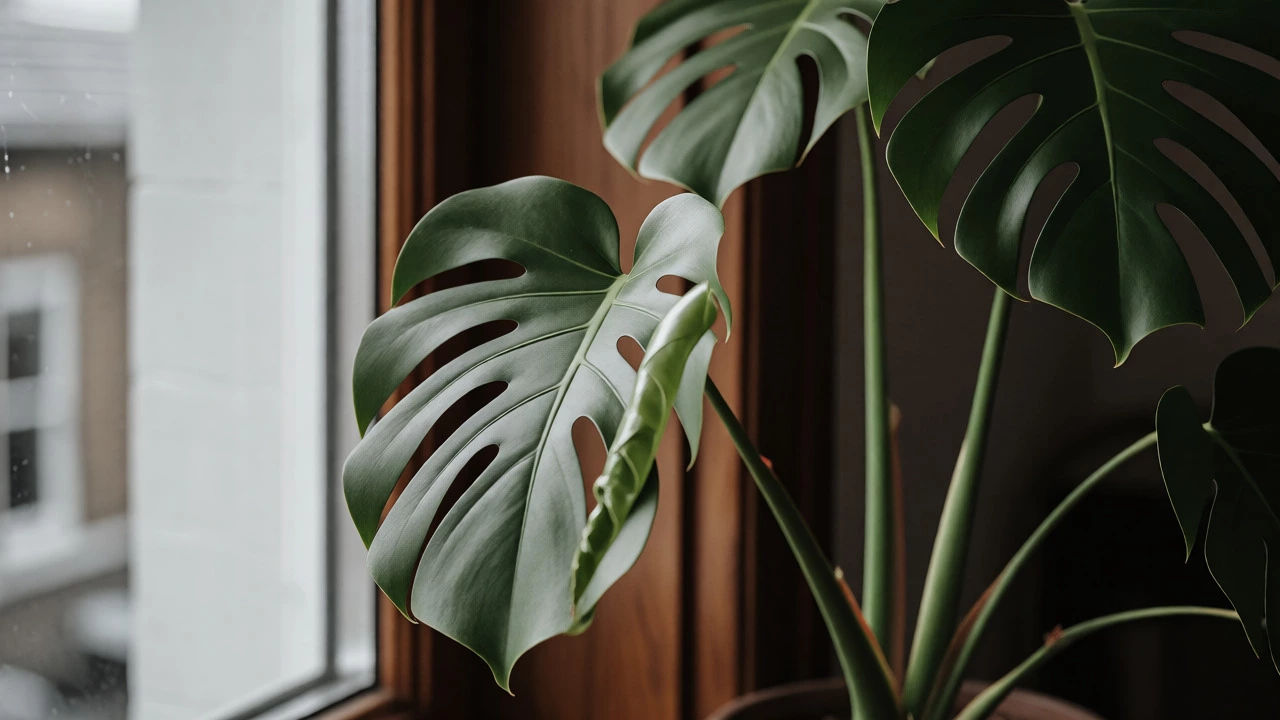
You just bought a beautiful Monstera deliciosa from the nursery. It’s lush, green, and promising. You place it on your north-facing windowsill, thinking you’re doing it a favor by giving it "gentle" light. Three weeks later, it looks sad. Leaves are yellowing, stems are stretching toward the ceiling like they’re trying to escape, and that new leaf? It never unfurled.
Here is the hard truth: most indoor plants do not need direct, scorching sun. But they absolutely need more light than you think. The biggest mistake people make isn't overwatering-it's under-lighting. We tend to judge light levels with our eyes, which adapt quickly to dimness. A room that feels bright to you might be twilight to a plant evolved for the forest floor or the open desert.
| Plant Category | Light Level (Lux) | Window Direction | Examples |
|---|---|---|---|
| High Light | 10,000+ lux | South or West (direct sun) | Cactus, Succulents, Fiddle Leaf Fig |
| Bright Indirect | 5,000-10,000 lux | East or South (filtered) | Monstera, Pothos, Philodendron |
| Medium/Low Light | 1,000-5,000 lux | North or Interior Rooms | Snake Plant, ZZ Plant, Peace Lily |
Why Your Eyes Lie About Brightness
Human vision is incredibly forgiving. If you walk into a dimly lit office, your pupils dilate within seconds, and suddenly everything looks fine. Plants don’t have pupils. They rely on photosynthesis, a process that converts specific wavelengths of light into energy. If the light intensity drops below a certain threshold, the plant stops growing. It enters survival mode. It won’t die immediately, but it will stop producing new leaves, drop old ones, and slowly starve.
To get an accurate read, ignore how the room feels. Use a simple rule of thumb: if you can comfortably read a newspaper without turning on a lamp, the light level is roughly 500-1,000 lux. That is often too low for anything other than a Snake Plant. For most tropical houseplants, you want at least 2,000-3,000 lux. How do you measure this? You don’t need expensive gear. Most smartphone apps now include a lux meter feature. Download one, point it at the spot where the plant sits, and check the number during the brightest part of the day. If it’s under 1,000, move the plant closer to a window or add a light.
Decoding Window Directions
Not all windows are created equal. In the Northern Hemisphere, the direction your window faces dictates the type of light you get. This is non-negotiable physics, not gardening opinion.
- South-Facing Windows: These are the heavy lifters. They provide intense, direct sunlight for most of the day. Perfect for cacti, succulents, and herbs like basil. However, direct midday sun can burn delicate leaves of ferns or calatheas. Use sheer curtains to diffuse the harshness.
- West-Facing Windows: Intense afternoon heat. Great for plants that love warmth and strong light, like Jade Plants. Be careful in summer; the late-day sun is hotter than morning sun.
- East-Facing Windows: Gentle morning sun. This is the sweet spot for many popular tropicals like Philodendrons and Monstera. They get enough energy to grow but avoid the scorching afternoon rays.
- North-Facing Windows: No direct sun. Just consistent, cool, indirect light. This is where "low light" myths live. While these spots are dimmer, they are stable. Snake Plants, ZZ Plants, and Pothos thrive here. Avoid putting high-light lovers like Crotons here; they will lose their vibrant colors.
If you live in the Southern Hemisphere, swap North and South. The principles remain the same: track where the direct sun hits and adjust accordingly.
The "Low Light" Trap
Nursery tags often say "Low Light." Read that as "Survives Low Light," not "Thrives in Low Light." There is a massive difference. A ZZ Plant will survive in a dark bathroom corner for years because it stores water in its rhizomes. But it won’t grow much. It will stay the same size forever. If you want your plants to actually look alive-meaning new growth, bigger leaves, and robust health-they need adequate photons.
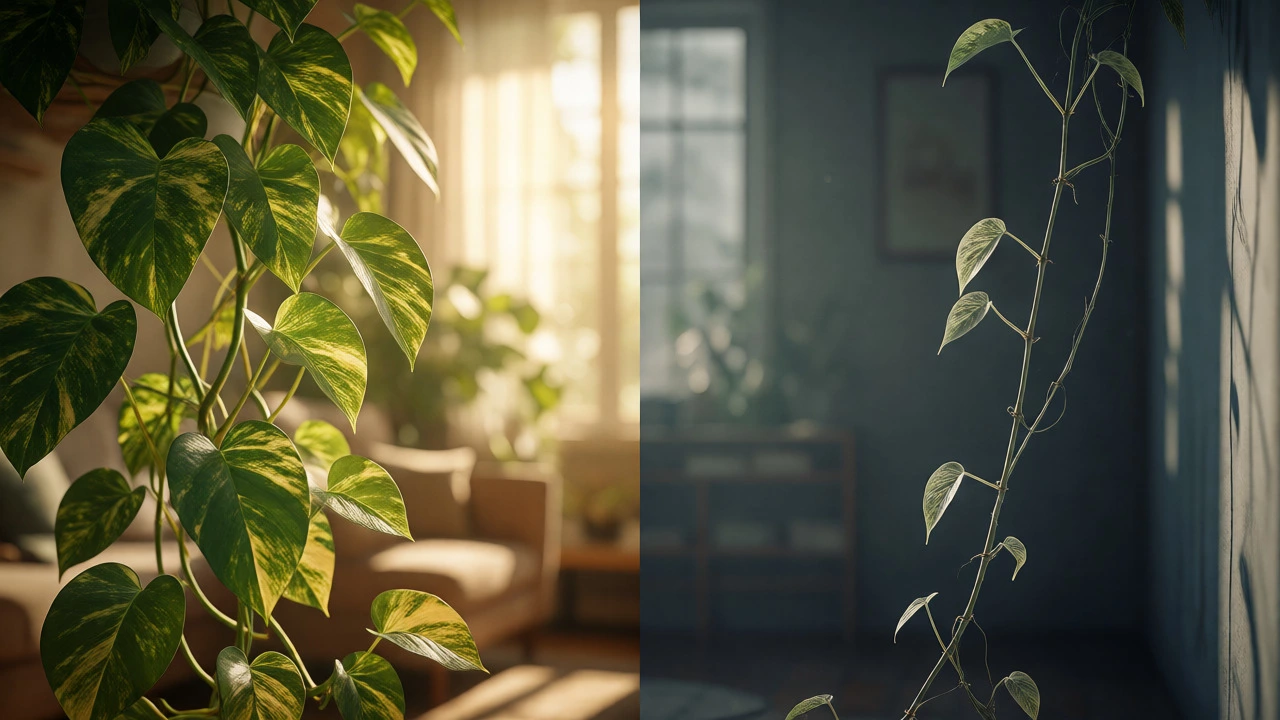
Consider the Pothos, arguably the easiest plant to keep alive. Put it in a bright room, and it will trail meters long with large, variegated leaves. Put it in a dark hallway, and it will stretch out, becoming leggy with tiny, pale leaves spaced far apart on the stem. The plant is reaching for light it isn’t getting. It’s working harder to do less.
When Natural Light Isn’t Enough
Maybe your apartment has no south-facing windows. Maybe it’s November in Seattle, and the sky is gray for six months straight. Relying solely on natural light is tough. This is where artificial lighting saves the day. And no, you don’t need to turn your living room into a disco with purple LEDs.
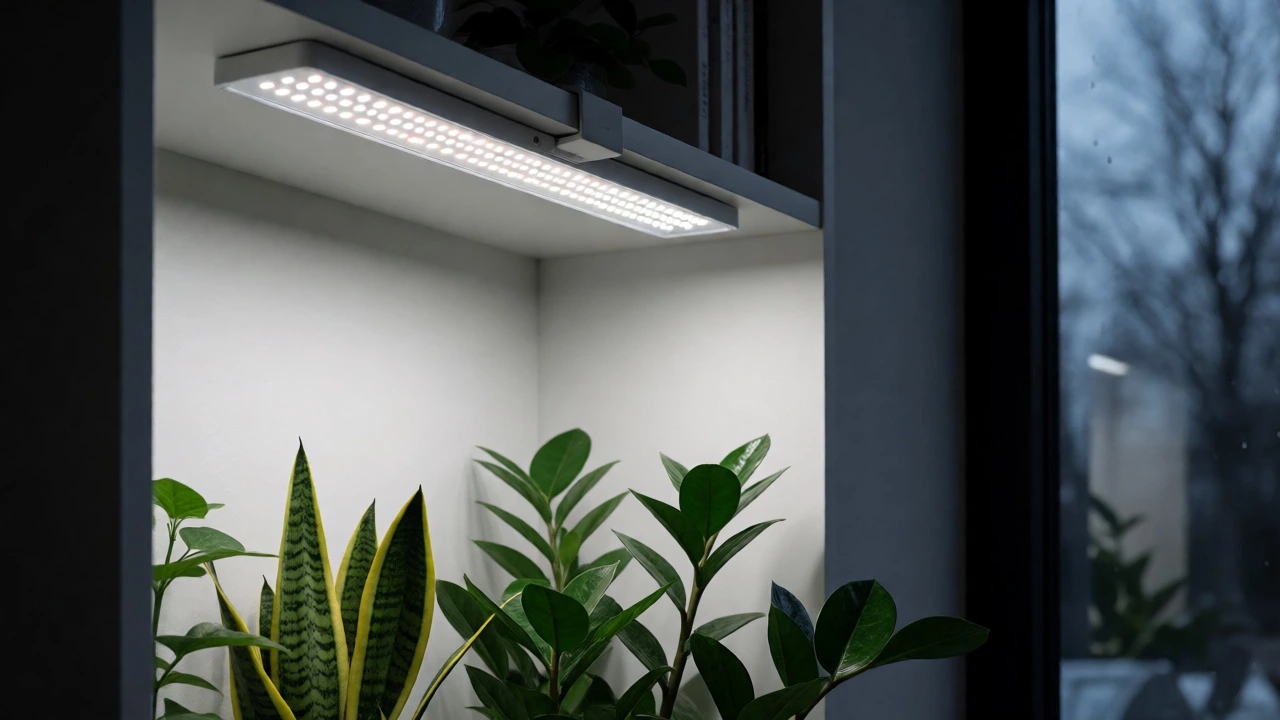
Modern LED grow lights are efficient, full-spectrum, and discreet. Look for fixtures labeled "full spectrum" with a color temperature around 5000K-6500K (cool white). This mimics daylight. You can clip them onto shelves, mount them on walls, or use smart bulbs in existing lamps. The key metric here is PAR (Photosynthetically Active Radiation), but for home users, simply aiming for a fixture that delivers 20-40 watts per square foot of plant area is a good starting point.
How long should you run them? Don’t leave them on 24/7. Plants need darkness to respire and rest. Aim for 12-14 hours of light per day. Use a cheap timer outlet to automate this. Consistency matters more than duration. A steady 12-hour cycle prevents stress and encourages predictable growth patterns.
Signs Your Plant Is Starving for Light
Your plant will tell you what it needs if you know how to listen. Watch for these specific symptoms:
- Etiolation (Legginess): Stems become thin and elongated, with large gaps between leaves. The plant is stretching desperately toward the light source.
- Leaning: The entire plant tilts significantly toward the nearest window. Rotate your pots weekly to prevent this, but remember, rotation doesn’t solve insufficient total light.
- Pale or Variegation Loss: Green leaves fade to yellow-green. Variegated plants (like Calathea or Pothos) may revert to solid green because maintaining colorful patches requires extra energy.
- Dropped Leaves: Lower leaves fall off while the top remains healthy. The plant is cannibalizing older leaves to feed new growth because it lacks energy.
- Slow or No Growth: It’s been three months since you saw a new leaf. In spring and summer, this is a red flag.
Adjusting for Seasons
Light availability changes drastically throughout the year. In winter, the sun is lower in the sky, and days are shorter. A spot that was perfect in July might be inadequate in January. During darker months, move your plants closer to windows. Pull them back from corners. Consider supplementing with grow lights even if you didn’t need them in summer.
Conversely, in peak summer, watch out for leaf burn. If you see crispy brown patches on leaves facing the window, the light is too intense. Move the plant back a few feet or add a sheer curtain. It’s a balancing act, but once you understand your specific micro-climates, it becomes second nature.
Practical Steps to Fix Light Issues Today
Don’t overcomplicate it. Start with these actionable steps:
- Audit your space: Spend ten minutes checking each plant’s location with a phone lux app. Write down the readings.
- Group your plants: Place similar light-needing plants together. Keep high-light plants near windows, low-light survivors further in.
- Clean your windows: Dust and grime block up to 20% of incoming light. Wipe both sides of the glass.
- Clean your leaves: Dusty leaves absorb less light. Wipe broad-leafed plants with a damp cloth monthly.
- Rotate regularly: Turn pots a quarter-turn every week to ensure even exposure.
- Add supplemental light: If readings are consistently below 1,000 lux for active growers, buy a basic LED bulb or strip. It pays for itself in saved plants.
Remember, there is no such thing as a plant that needs "no light." Even shade-tolerant species require some ambient illumination to perform basic metabolic functions. By understanding the real light dynamics in your home, you stop guessing and start growing. Your plants will reward you with greener, fuller, happier foliage.
Can I use regular household bulbs for my plants?
Yes, but with caveats. Incandescent bulbs produce too much heat and waste energy, which can burn leaves. Standard CFLs work but are inefficient. LED bulbs are best. Choose ones labeled "Daylight" (5000K-6500K) rather than "Warm White" (2700K-3000K), as the cooler spectrum promotes vegetative growth. Ensure the wattage is sufficient; a single 9W LED bulb is usually only enough for one small plant.
Is artificial light better than natural light?
Natural light is generally superior because it includes UV rays and varying intensities that help plants develop stronger structures and pigments. However, artificial light provides consistency and control. In winter or dark apartments, artificial light is often "better" simply because natural light is insufficient. Many successful indoor gardeners use a combination: natural light when available, supplemented by LEDs during dark hours.
How close should a grow light be to my plant?
It depends on the light intensity. For standard LED bulbs, 6-12 inches above the canopy is typical. For high-output LED strips or panels, follow the manufacturer's guidelines, often 12-24 inches. If the leaves feel warm to the touch after an hour, the light is too close. If the plant stretches toward it, it’s too far. Adjust until the plant grows upright without leaning.
Do plants sleep at night?
Plants don't sleep like humans, but they do require a period of darkness. During the night, plants undergo cellular respiration and other critical processes that differ from daytime photosynthesis. Leaving lights on 24/7 stresses most common houseplants. Stick to a 12-14 hour light cycle followed by 10-12 hours of darkness.
What happens if I put a sun-loving plant in a dark room?
The plant will initially survive by using stored energy reserves. Over time, it will exhibit etiolation (stretching), lose lower leaves, and stop growing. Eventually, it will decline and die. High-light plants like succulents, citrus trees, and crotons cannot adapt to low-light conditions indefinitely. They need high photon flux density to maintain their structure and metabolism.